A guest blog for Organ Donation Week 2026, from Andy Prigg…
Last year I wrote about the ring I wear every day, and the words engraved on it: Ad astra per aspera. This year I want to write about a conversation, and a piece of paper that only 1 in 10 recipients ever pick up a pen for.
This year I want to talk about the importance of saying thank you — particularly to donors, and to donor families.
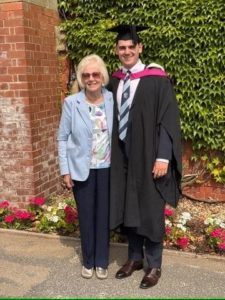
This year also brought its own milestone worth marking — a graduation, from a degree I did in the same year as my transplant
The background
Since I last wrote, I’ve spent two months with the transplant team in Oxford. It was truly brilliant; cutting-edge science, delivered by excellent clinicians, and it was a privilege to be part of it. But I noticed something while I was there, something I keep coming back to: the people at the centre of the whole process are so often kept in the background. The recipients get the headlines. The science gets the funding announcements. But organ donation can only happen at all because of the generosity of donors — and that generosity so rarely gets acknowledged directly, by name, by the people it saved.
Saying thank you
I wrote my letter to my donor’s family at the earliest opportunity I could. But most people don’t. The more I’ve learned through my work on this project, the less that surprises me — and the more it troubles me.
There’s a tension I sit with often: knowing how much a letter can mean, and knowing exactly why so few people manage to send one.
Talking to donor families
I recently met the mother of a donor.
We spoke a lot about letters. She told me they don’t need to be complicated — they can be as simple as saying thank you. That simplicity is easy to forget when you’re the one holding the blank page, agonising over every line, worried about getting it wrong. To her, “wrong” wasn’t really the risk. Silence was.
Since losing her son, she has channelled that loss into the Will Houghton Foundation, campaigning to raise awareness of organ donation and to support donor families — work that’s easy to overlook if you’re not looking for it, and impossible to overlook once you’ve met the person behind it.
One thing she was clear about: there’s no expectation of a response. Writing isn’t a transaction. But it closes a circle, for the family who gave, and, I think, for the recipient too.
The reality is nothing like the reunions TV likes to make out. Most donors and recipients never meet, and most families never get more than a letter, mediated and anonymous, passed through the transplant coordinators. That letter might be the only piece of the recipient’s life a donor family ever sees. It matters more, not less, because of how little else there usually is.
Oxford, and the other side of the science
Two months with the transplant team in Oxford was brilliant, and exhilarating – if not tiring!
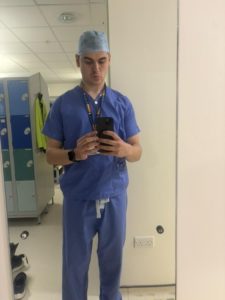
The middle of the night/ early morning in Oxford
But more than the science, I found myself thinking about the people the process runs through — not just the recipients, but the donors, and the families left behind who said yes at the worst possible moment of their lives.
The research
Right now, I’m working with NHSBT on a study looking at why so few UK recipients write to donor families. The figure that’s stayed with me since I started is this: only around 1 in 10 recipients ever write. Not because they don’t want to (most say they do) but because of things like:
● Fear of saying the wrong thing, or not enough
● Guilt at being the one who lived
● Not knowing whether a letter will help a grieving family or reopen a wound
● Simply not knowing where to start, or that it’s even possible
Knowing all of this professionally sits alongside something I already know personally, from having written mine. It wasn’t easy, even when I was sure I wanted to do it — which is exactly why I understand why so many people, who are just as grateful, never quite manage to.
If there’s one thing I want this post to do, it’s to gently push back on those barriers directly: if you are reading this, and you’ve received a donation, please consider writing. I think it matters enormously. There is no wrong time to send it — not six weeks after, not six years after. And it doesn’t need to be profound. It can be as simple as thank you. From everything I’ve learned through this project, and from families like Will’s, that’s very often enough — sometimes it’s everything.
What’s changed since I wrote last year isn’t the gratitude — that hasn’t moved. What’s changed is that I now feel well enough to start trying to make some positive change. NHSBT’s own Pass It On campaign has always been built on that same idea — that the most powerful thing any of us can do is pass the conversation on to someone else.
Closing
This Organ Donation Week, I want to encourage the conversation Live Loudly Donate Proudly has always stood for — not just the conversation about registering, but the one that comes after. The one on the other side of “yes.”
Because through hardship, we can reach the stars.
I’d ask anyone reading this who hasn’t yet written: don’t wait for the right time. There isn’t one — just the next one.
Please, if you have any questions or need any help in writing, don’t hesitate to reach out.
https://www.nhsbt.nhs.uk/how-we-help/donor-family-care-service/
donor.familycare@nhsbt.nhs.uk